This lyric from Ani has always resonated with me, on a few levels:
People used to make records
As in a record of an event
The event of people playing music in a room
Now everything is cross-marketing
It’s about sunglasses and shoes
Or guns and drugs
You choose
Nowadays, even “recording people in a room” is not a done thing. That is, the multi-track recording process and expectations on production mean that parts are recorded separately, one at a time, for the most part. There are of course pros and cons to this… but either way, the recording of an “event”—a moment, a particular instance of a specific, singular performance—is no longer really the case.
And today, so often the recording is done at home. In a bedroom or, if we’re lucky, a room set aside as a music space. But not a dedicated studio, no live room, no people playing together.
We’ve definitely lost something in the process. But we’ve also gained a lot—it means that artists like myself are able to produce work without the backing of a label, under our own steam, with our own gear, and get a professional quality, releasable result, for a few thousand dollars. This is still a lot of money, but it is a far cry from what it used to cost. That means more art in the world, accessible to more people. (I’ll save my thoughts on “lost something” part for later posts.)
I’m on the cusp of “officially” launching my latest single, Something More (it’s already available, but I haven’t done all the things™ to promote it etc.).
It’s a song that has been a long time coming. I wrote it probably about 4 years ago, and I’ve had a few false starts trying to “commit it to tape.” I recently had a lil’ break from work, and got struck with the motivation and energy to take another stab at recording it, at what I affectionately call “Moon Table Studios”—named after the beautiful white-glass dining room table that I spent most of my time at during recording and mixing.
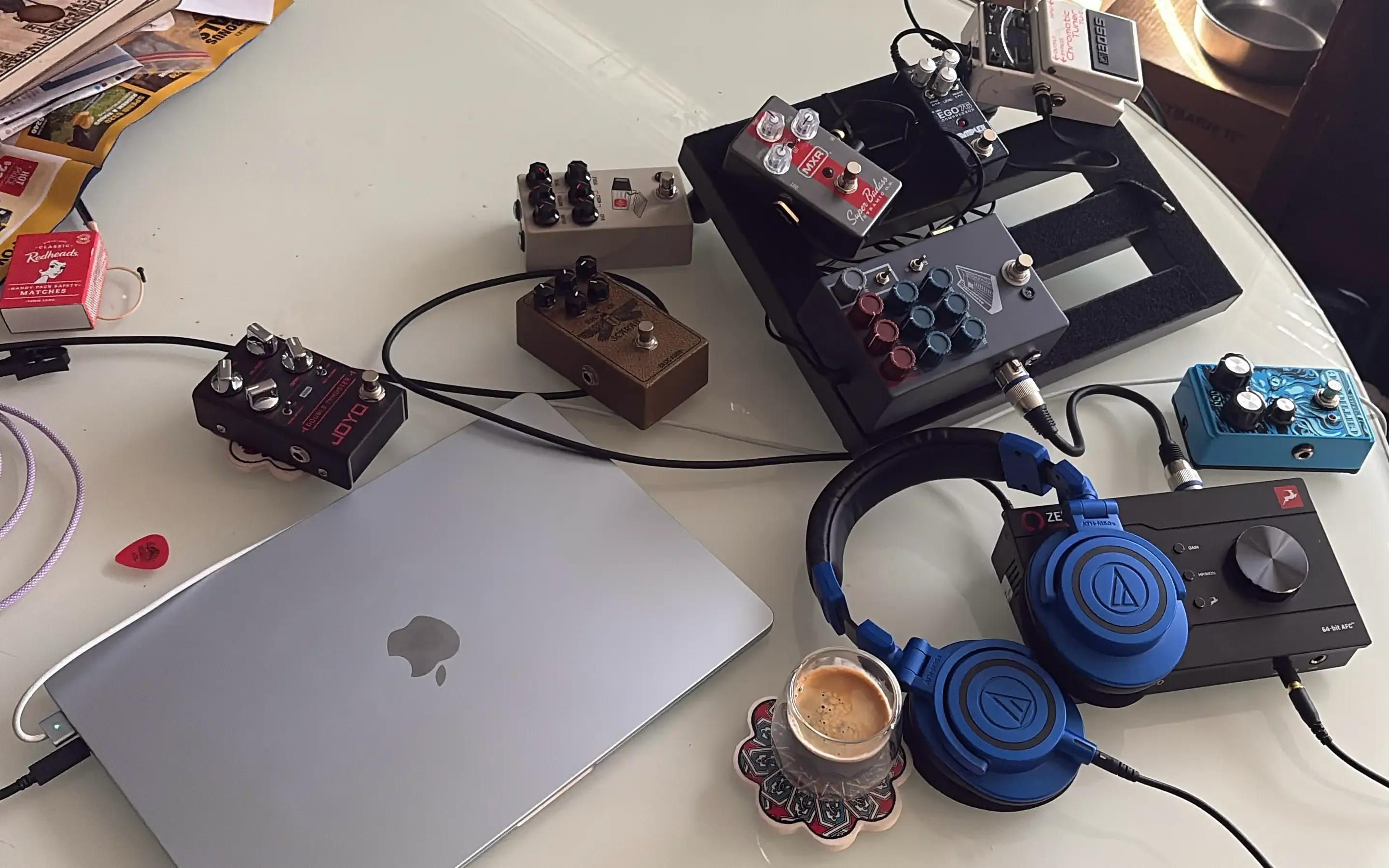
A snapshot of a “day in the life” at Moon Table Studios
Mid-way through the recording it struck me just how the make-shift setup that I’ve built over the years is the fulfilment of a childhood dream.
When I was a teenager, my Mum—bless her—was just making ends meet after separating from my Dad. Single-income, working admin jobs at service stations, appliance repair and trawler companies. I seriously don’t know how she did it… I had a part-time job at KFC, but between the two of us there was very little money for anything beyond the necessities. Even a good pair of basketball shoes was a stretch—I was playing in $20 Kmart specials for a good while, before my Mum was able to put a pair of the cheapest Nike boots on a credit card—just as I was getting to regional-representative level in the sport.
In any case, music-related expenses like guitars and keyboards and recording equipment were way outside of the budget. At one point we moved next door to someone who has become a lifelong friend, Ashley. Ashley’s family were not well-to-do either, but through his part-time job he was able to buy the odd bit of second-hand music gear, more than I could anyway. He was mostly into synths—a Roland Juno 6 (I think), a floppy-disk based sequence recorder (it might have been the Kawai Q-80), a Casio then Yamaha all-in-one that had surprisingly good sounds given its price point. But also some cheap outboard gear like Roland’s half-rack reverbs and delays, and the odd guitar pedal.
MIDI was in its infancy, and it was hard and complex, especially for two high-school kids without mentors or peers that were similarly exploring and experimenting. Of an afternoon after school and on weekends we’d hole up in his bedroom and try to cobble together sequences of Harold Faltermeyer’s Axel F theme, and recreate the sounds of the songs we loved from Depeche Mode and others. Mostly unsuccessfully, but it was (kinda) fun, and immensely satisfying when we (mostly Ashley) were able to pull something off…
Since those early days, I have been enamoured with digital music technology, and always dreamt of being in a studio to record, or even owning my own—initially as an instrumentalist, and later as a songwriter. Those early experiences led me to major in Music Production at university, but being able to afford the gear was always a challenge. I was borrowing money from my Dad for basic things like a bass amp and new bass guitar for my other major in Bass—paying it back from gig money and my holiday work in hospitality.
At some point I managed to be able to get an Atari 1040ST with a monitor, chair and small desk second-hand, running a cracked version of Cubase, and a Yamaha SY22 keyboard. As a not-very-good keyboard player, I was delighted to be able to record a few sequences of my short instrumental compositions, and proud of my attempt to record a multi-layered MIDI version of the Terminator 2 theme.
I was privileged to be able to access the studio gear at uni—including a “MIDI lab” with samplers and a bunch of stuff that I never really grokked. I mostly spent time in the analog studio, which was home to an Otari 2” tape machine and a desk I can’t remember (friends from uni suggest it was from Sound Workshop Series 34). A few outboard effects like a Lexicon digital reverb unit. This was not cheap gear, and unlike a lot of education institutions at the time, a genuinely commercial-grade set up.
But it was still all a bit too hard… and way too expensive.
Fast forward a few years, and I’m in my first job, with a little bit of disposable income and access to credit. I was mostly putting that towards buying an acoustic guitar to write on, my first personally-owned-not-hand-me-down stereo (I still have the speakers and carousel CD player in active service, alongside my Mum’s turntable from the 80s!).
Around 2001 I had my heart set on buying an eMac, with eMagic Logic (before Apple bought it out), and a Presonus Firebox two-channel interface, to start capturing ideas and recording demos. I am forever grateful to my “boss” and co-founder in Saasu, Marc Lehmann, who bought an eMac for browser testing (genuinely and legitimately), but let me use it for my music, so that I could get a basic home recording system up and running.
Even then, Logic had come a long way from the Atari-hosted Cubase version I had used, and was even a far cry from the early version of Protools (like it was literally version 2.something IIRC) we weren’t allowed to touch at uni. I was able to record a few demos and I felt I was finally moving towards that dream I’d had since school. Given my nascent skills, the recordings sounded dreadful, of course… far from releasable. But I was only after demos and it was a big step forward.
The next big leap was my introduction to Ableton Live. Again, my friend Ashley was involved—I’d picked up a “free” version with a MIDI controller I’d bought, but couldn’t make heads nor tails of it. I caught up with Ashley in person at some point, and he showed me the basics of how the Clip vs. Session view ticked—it was more a mental-model shift than a technology blocker—and that was just enough for things to click into place.
Clip view was a revelation—being able to sketch out tracks in small riffs and beats and parts, looping them, re-constructing them… just awesome. And while Session view was still in its infancy, I loved how I could then take those basic building blocks and create an arrangement out of them. I took that learning into my band Fuzu and created a number of live performance patches, later translating them into bed tracks for our recorded works.
Around 2018 something prompted me to embark on building my skills to produce a “releasable” product. I joined Produce Like a Pro (thanks Warren!!) and devoured tutorial after tutorial on YouTube, and got to a point where Bones felt like it was the proverbial “spitting distance” away. I’m not sure what triggered the thought, but this success and momentum led me to attempt doing a full EP of 4 tracks, which became Letting Go.
I was still using a first generation Focusrite Scarlett 2i2 (I loved that unit—and it was awesome for live performance. I really don’t get the hate they seem to get). With only 2 channels, and nowhere near the budget for a studio session—I purchased Studio Drummer. After a LOT of trial and error and time spent in the MIDI editor in Live, I was able to get a result I felt was release worthy. I’m not a fan of programming drums in this way, on a whole number of levels, but I feel like I got a result that I felt was a reasonable approximation of what a live drum recording might sound like.
Mixing took forever. And I was purchasing Waves plugins left, right and centre trying to assemble the foundational components that I was learning about through my self-directed study (i.e. YouTube).
My Mum passed away towards the end of that project, and she was generous to leave what she’d been able to build over her years to my brother and me. I spent some of my inheritance on my passion for music, which I think she would have approved of. I picked up an Antelope Orion Studio Synergy Core twelve-channel interface, and a bunch of quality microphones to record drums and guitar. (Musos Corner loved me for a hot minute!)
As an aside: the Antelope is incredible! For anyone considering Universal Audio interfaces, the Antelope options are better bang for buck IMO and top-notch quality, with very similar features like hardware accelerated mic, amp, cabinet and outboard effect emulations.
There was a hefty price tag associated with this rig, but that gear has enabled me to run multiple sessions recording a full drum kit—which you can hear on Love Them Hard, featuring my Fuzu bandmate and long-time friend Toby Forage.
With that recording, the penny dropped: I’d finally achieved that dream—being able to do a full recording with my own studio equipment. This was a real “full circle” moment for me. I feel immensely blessed for this—I mean, at a deep, deep level.
Since then, I have found myself being split between my studio space in Hazelbrook (where I have my 12ch unit set up in a rack system) and home—so I picked up an Antelope Zen Go Synergy Core two-channel interface for when I’m working at home. This allows me to take advantage of the two Antelope Edge Solo microphones I have, and the hardware accelerated gear emulation when I’m recording parts at home. (There are features on the Antelope that make it ideal for my live performances too, but that’s for another time.)
For the recording of Something More, I ended up doing it all from home. At one point during my recording binge I took a photo of my setup, so I could remember some pedal settings. In that moment, it dawned on me just how amazing it is to have the ability to create such rich, releasable work from my dining table.
Like, seriously, incredible.
There’s a whole other post and argument about the decimation of an industry and skillset, and how this shift makes it ridiculously difficult for musicians to produce their own work—but I’ll save that for another day.
In this moment, I’m just feeling blessed and in awe and grateful to have the capability to be able to record and release my own music, to a quality I can be proud of, to have my music out “in the world.”
I’m grateful for technology advancements, for the reduction in cost over time, for the skills I picked up and access to gear I had during my time at uni, for the incredible work of the software and hardware makers like Antelope, Ableton, and the plugin ecosystem, for the people that have shared their experience and expertise so generously on YouTube and in forums and articles that are freely available on the ’net, for the financial position I’m in to be able to afford the equipment I have, for the job I have that enables me to be able to take time off work to apply the focus on a project like this, for my friends who are ever-so-patient with me as I drop desk mixes, real mixes, and masters on them for feedback (I’m thinking of you Krusty).
Thank you, thank you, thank you…
Gear list for Something More:
- Guitars: Reverend Charger 290, Reverend Kingbolt RA, Gibson Tribute Les Paul
- Bass: Warwick Streamer LX 5 (2000s era)
- Pedals: JHS Hard Drive, MXR Super Badass Dynamic OD, MXR Duke of Tone, Electro-Harmonix Big Muff Pi Deluxe, Wampler Mini EGO76, Strymon Iridium; Bass: Joyo Double Thruster, JHS Colour Box 10
- IO: Antelope Zen Go Synergy Core USB (multiple amp and cab emulations used for guitar tracking)
- Mics: Antelope Edge Solo microphone (U67 emulation)
- Monitoring: Audio Technica M50x headphones, Waves Abbey Road Studio 3, Yamaha HS7 matched pair (along with various other iPhones, headphones, stereos, cars)
- Apple M4 MacBook Air 15”
- Ableton Live 12
- GetGoodDrums “The Downbeat”
- A variety of other plugins and effects (let me know if you want a breakdown)