The keen-eyed among you (given the massive size of my readership, probably no-one! 😏) may have spotted a panel in the I Made This section of the home page, entitled “Anachron Guitars,” tagged as coming soon.
This is a nascent idea that I’m working towards, one of my many muses.
When I was undergoing surgery a few years back—and subsequently stuck flat on my back for about 6 weeks—I completely binge-watched probably hundreds of YouTube videos on guitar building, pickups, and related topics.
It was fascinating to both learn the techniques involved in building and finishing a guitar, and to realise how much effort goes into making an object of that nature. There is so much to do, especially around necks and fretboards.
This is extraordinary when you consider that a guitar usually costs in the range of $500–3000. Of course, some name brands and boutique builders charge more, but I would say a majority of the guitars I see on the shelves at my local music stores are in that range.
I’ll be honest—how manufacturers are able to build quality necks in the low-end price point makes absolutely no sense to me. Incomprehensible.
Anyhoo, while stuck in bed and on the couch, I started to imagine a bunch of different designs that I’d like to try. Different pickup combinations. Styles of body. Types of necks. Multi-scale vs. standard scale.
I was particularly interested in how I might apply CNC machining to create the base components (body and neck), to then be hand finished. I’d seen that my favourite bass brand in the world, Warwick, did this, and had therefore looked up a bunch of videos to see how this technology—which has radically reduced in cost in recent years—was being used in smaller, boutique and home-based builders. This would bring together two passions—digital making and music—in a new way. Perhaps I could wrap my head around it, and bring something new to it?
I must admit, I even surprised myself how obsessed I became with the idea, and how deeply my interest and imagination went. My partner questioned it a few times over that period, too! I think part of it might have been a mental-emotional “survival” mechanism (I have since determined I was experiencing PTSD from my experience around post-surgery complications). But, I also sensed there was something more going on…
Upon further reflection, I have come to realise that this has been something on my mind for a very long time.
Early interest
It started when I was in high school (40-odd years ago), when I used to jump on the bus or ride my pushbike up to Mooloolaba to hang out at a music store there.
I was one of those “annoying loitering kids” at that store. Despite this, the owner, Gary Brown (IIRC), was very kind and supportive of me. He was an aspiring luthier and had started making a hybrid acoustic/electric guitar custom design, echoing the Telecaster body shape.
Think something like the Godin A6, but hand-crafted in a workshop in coastal Queensland in the ’90s. Gary had presented one to Tommy Emmanual, and my recollection is of photos and posters signed by Tommy around the store.
The design supported both electric, acoustic, and nylon strings—with various combinations of traditional pickups and the piezo pickup system he had installed. I was totally intrigued, inspired, and super-impressed. Gary gave me a guided tour of his workshop (probably more than once). But I was super shy, and didn’t feel at all comfortable or confident asking if he could show me how to do anything.
This was at a time when I was just starting to really get into bass playing. I’d bought the very first edition Bass Player magazine and was constantly smitten by the ads for the boutique builders in the back. Dreaming of one day owning one of these beautiful, bespoke-built instruments.
Warmoth were a consistent advertiser in the magazine, back when there was a positive synergy and value exchange between advertiser, reader and journalist/publication. Looking at those Warmoth ads, I dreamt of having the money to “build my own bass” some day…
First steps: a “Parts-caster”
In 2016, I received a higher-than-expected tax return (a rare event, indeed!!) and I decided to put that money into fulfilling that dream—building a bass from Warmoth body parts, sourcing my dream “hardware” list, and wiring the electronics up from first principles.
After MUCH deliberation and research and sifting through the plethora of options in front of me, I ordered a body, neck and select components from Warmoth, a set of vintage-spec PJ pickups from Lindy Fralin, a Babiscz bridge, Hipshot tuners (including a D-Tuner that so many people ask about when they see that bass) and other assorted components.
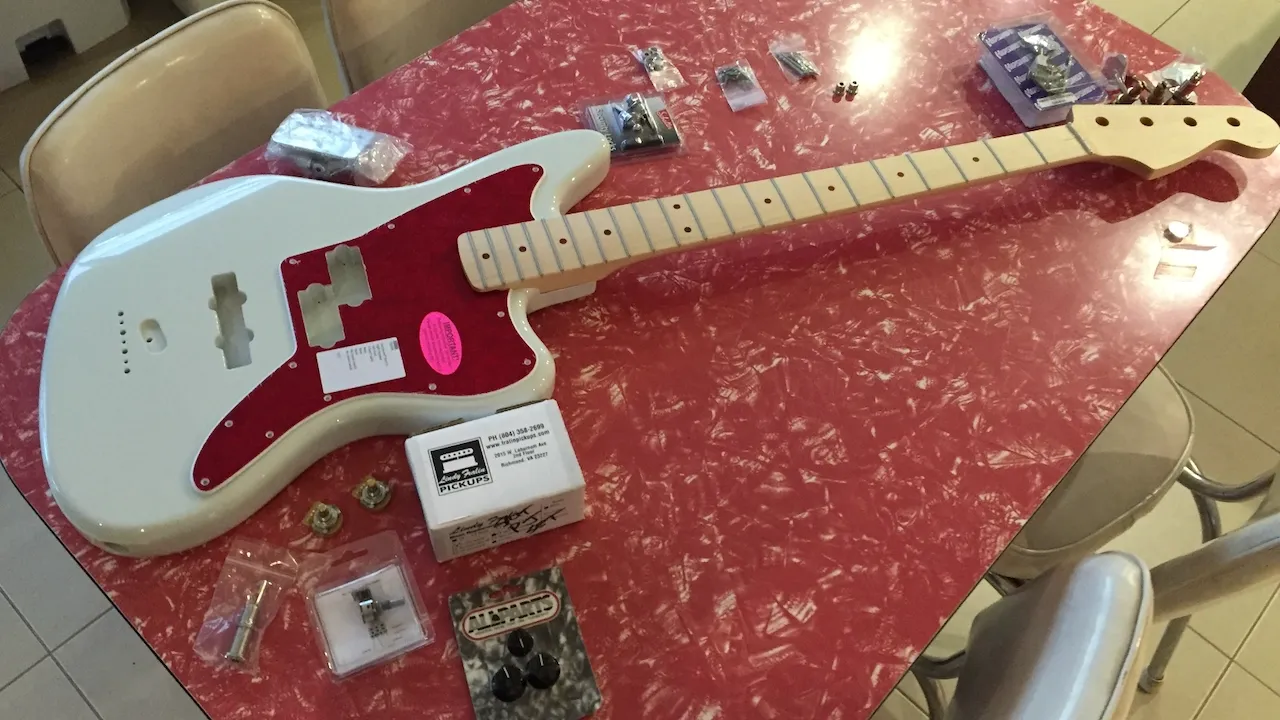
Under construction… Warmoth Jazzmaster IV body, custom maple neck, and other parts when they arrived.
The build went (mostly) well. Despite a few hiccups and close calls—like mispositioning the string tree drill hole 🤦🏼♀️, but in a position where I was able to cover it up 😮💨—I was super-happy with the result.
So, had the itch been scratched? Sorta… well, at least for a moment.
Building from a (body) blank
Watching all the videos after my surgery just reignited that interest and passion. What if I could go beyond just buying pre-shaped body and neck components, and start to build my own?
I looked into purchasing pre-cut templates, but most were in the hundreds of dollars, and even more with the ridiculous inflation we’ve seen on shipping costs out of the USA in recent years. Considering you can buy an entire guitar for the cost of these templates—and I was broke—that wasn’t going to fly.
But I could afford to buy a body blank, neck and fretboard blank kit from a local timber supplier (who has since stopped selling), and found a 50s P-Bass template form Electric Herald. I contemplated getting the plan/template printed out to A0 at a local printer, and doing it the “old fashioned way”, but a friend offered to try out their CNC router to create an MDF template instead.
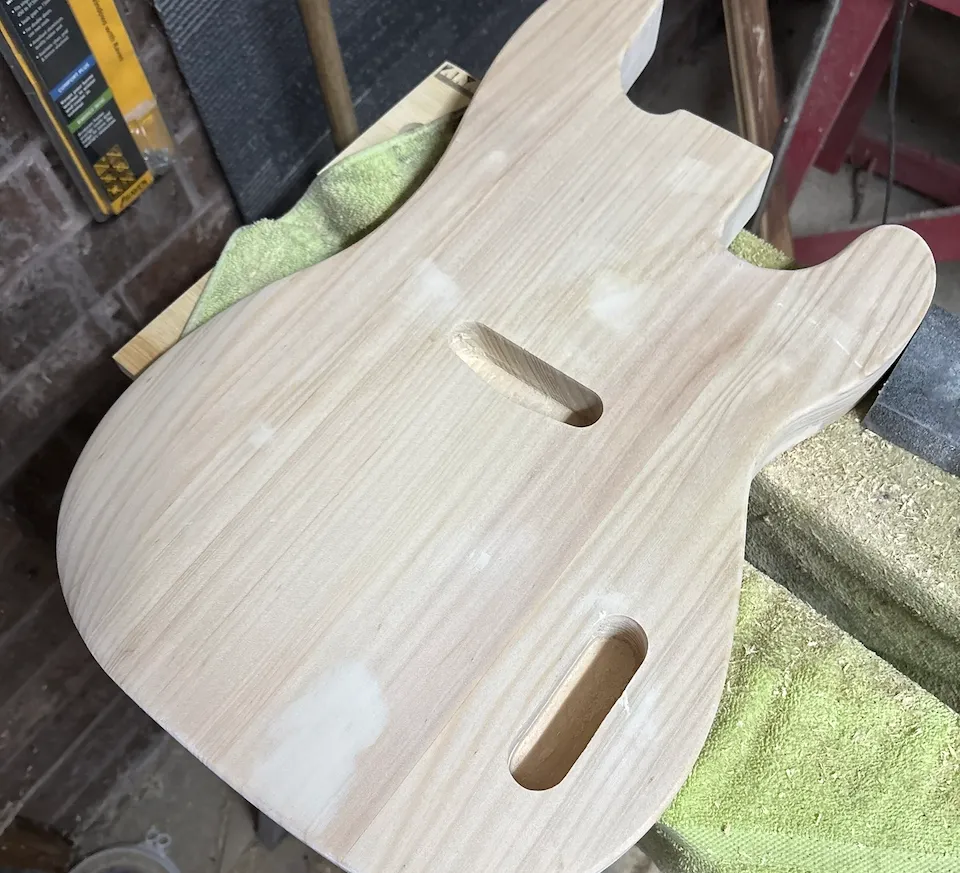
A work in progress snapshot of the 50s P-bass body, prior to the “mishap”.
I hand routed the body shape and pickup/control routes using the template. Hand carved the arm and belly contours, which worked way better than I anticipated. Used a round-over bit to get a nice edge to it. It was coming along nicely… until I stuffed up the neck route.
How I’d constructed my templates wasn’t quite right, and being impatient—in part due to the limited time I had each week to give to the project—I decided not to wait and fix the template properly, plowed ahead and… well…
This is all fine, of course. It is the nature of trying something new. Ani Difranco says:
A lesson must be lived, in order to be learned.
Or as the affirmation I have in my phone reminds me regularly, you have to
Be brave enough to suck at something new.
That particular project is currently stalled until I can pick up another body blank. But… I will be having another crack at it soon, this time with the aim of getting the CNC to do a bit more of the work, especially around the neck route/joint!
Importantly, feels within reach that I’ll be able to build my own bass and guitars in the near future.
And, suffice to say… I’m hooked.