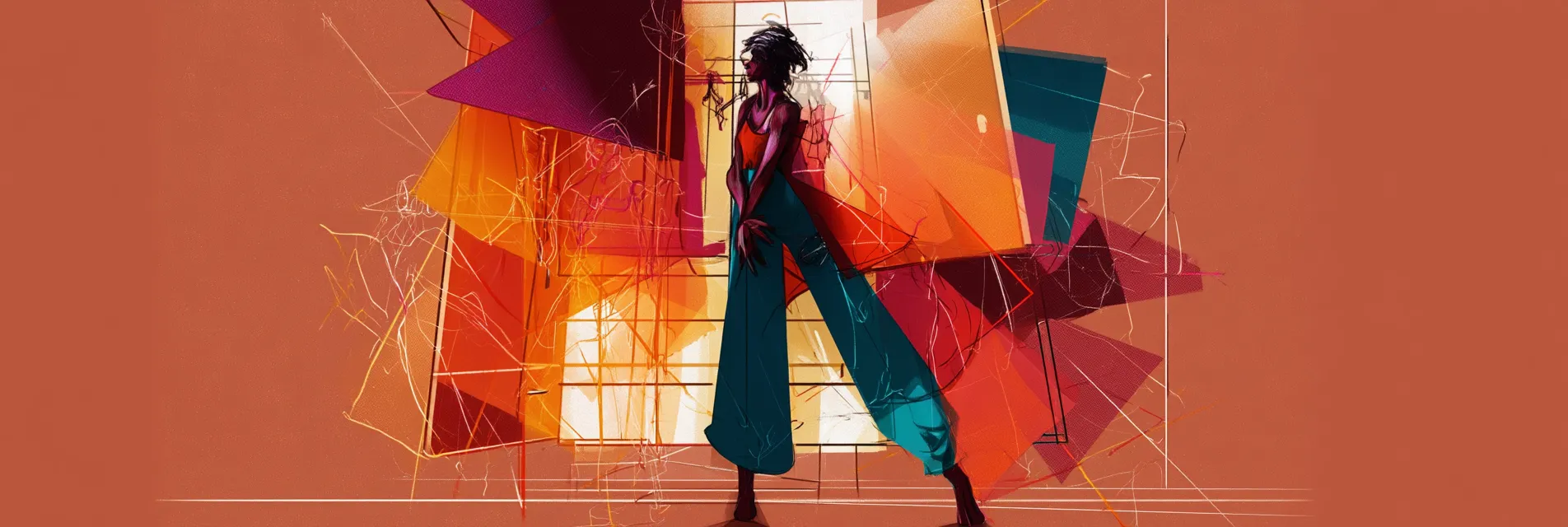
In times like these, it can seem like a strange thing to be focused on fashion.
There are bigger battles. There are rights being contested, protections being stripped away, communities being told—in law, in policy, in the loudest possible public terms—that they are a “problem” to be “solved,” that we don’t even exist!
Within all of that, surely thinking about clothes should be the last thing on our mind?
I want to sit with that question for a moment…
The idea that fashion is frivolous—decorative, superficial, the concern of people with too much time and too little seriousness—is a particular kind of privilege. One that most people can afford to hold because, for them, it’s mostly true. They get dressed in the morning, they look fine, they go about their day. Clothes are backdrop.
The kind of questions being asked in the mirror are: does this look good on me? Or do I feel good in this?
For a trans woman, the questions run much deeper.
What we wear is not separate from who we are. For those of us whose bodies do not yet, or may never completely, reflect the self we carry inside, the relationship between clothing and our core identity is not just incidental. It is one of the primary ways we are perceived by others as who we really are. Our clothes speak for us in a much deeper way than many folx may realise. Our wardrobe is load-bearing.
How will I be read? Will I walk into the office, the pub, the supermarket, and be seen as who I am, or will something “give me away” and change the temperature of the room?
I don’t think this is just me? Have you had this sense, that your clothes are speaking for you and doing some of the “heavy lifting” in your day to day experience? Let me know in the comments about your experience…
This is not about style. It is not about trends, or looking good in a particular moment, or finding the outfit that gets the most compliments. (Although that is always nice when it happens!) It is something far more foundational.
When I talk about clothes, I am talking about the difference between moving through the world as myself, or moving through it as something I am not. I am talking about the experience of being seen—correctly, or incorrectly—by every person I encounter.
I am talking about safety. About the low-level calculation that many of us run, every single day, every time we get dressed: Will I be safe? Will this carry me? Will this let me be who I am without cost?
That is not a trivial calculation. That is not a question of aesthetics.
For trans people, our experience of gender is something that lives very deep in us, a foundational truth about who we are that our bodies, as they were given to us, do not always speak clearly. Clothes are one of the ways we speak that truth. They are not an outer layer in the shallow sense. They are a translation. A declaration, even.
To dismiss fashion as frivolous, in this context, is to misunderstand what fashion is doing for us. It is carrying something real. Something that matters. Something that, in the current political climate, is being actively contested.
I’m writing this at a particular moment in time. I won’t name every headline, because you probably already know them… feel them… you’re living inside them. The hostility directed at trans people, and at trans women in particular, has become louder, more organised, more emboldened. It shows up in legislation. In opinion columns. In conversations that people have in front of us, sometimes, as though we aren’t there or don’t count or won’t push back.
These things are not abstract. They land in the body, and spirit. They change how we move through space.
And they make the question of what we wear, and how we wear it, and what it allows us to be, more urgent, not less.
I am pursuing Kinfolx in this moment, not despite what is happening in the world, but because of it. Not from a place of reaction, not built from anger (though anger is present and legitimate), but from the belief that showing up fully, in clothes that fit and hold and represent you correctly, is itself a form of resistance.
The hostility directed at trans women right now is trying to make us smaller. Less visible. Less certain of our right to exist in public space.
There is something quietly defiant about dressing well. About walking into a room without apology. About wearing something that says: I am here. I exist. I belong. I am not going anywhere.
Clothes cannot fix what is happening in the world. But they can hold us while we fight.
Does this resonate for you? Do you feel your clothes are supporting you in some way right now? More than usual? How? I’d love to hear your thoughts in the comments…
And for that reason, expanding the options for what trans women can wear—designing for our bodies, our lives, our full range of needs—feels like exactly the right place to be putting my energy right now.